Why the Derma Chair You Pick Affects Patient Throughput

Most dermatology clinics spend serious money on lasers, peels, and consumables. The chair in the middle of the procedure room gets far less attention. That’s understandable, it doesn’t feel like the flashy part of the investment. But the derma chair is where your patient spends the entire appointment, and how it performs directly shapes how many patients you see in a day and whether they leave satisfied.
This is not about comfort as a luxury. It’s about what happens to your schedule, your staff workflow, and your patient retention when the chair is wrong for the job.
The Time You Lose Between Appointments
Every patient transition involves repositioning. Backrest up, leg rest adjusted, height raised or lowered for the next patient and the next procedure. On a manual derma chair, your technician cranks through each adjustment. Then checks, cranks again, gets the angle close enough, and moves on.
On an electronically motorised chair with a programmable handset, that same repositioning takes seconds. You press a button, and the chair moves to a saved position. That likely saves three to four minutes per patient transition. Across ten appointments in a day, you recover 30 to 40 minutes. That’s enough for one more appointment, sometimes two. Over a month, the arithmetic gets attention-grabbing.
What Happens When a Patient Is Uncomfortable
There’s a less obvious angle here.
When a patient is not properly supported, back strain, legs dangling, neck at the wrong angle, they shift. They ask to pause. They tense up and make the doctor’s job harder. A 30-minute procedure stretches to 40. Your next patient waits. Your staff gets rushed.
A well-configured derma chair keeps the patient still. Proper lumbar support, correctly angled leg rests, a backrest that holds position without drifting, these are operational features, not extras. Patient stillness lets the doctor work faster and with better accuracy. It also reduces procedure-related complaints, which matter more than most clinic owners realise until they start reading their own reviews.
The Cost of Getting the Wrong Chair
This is what no one will tell you when it comes time to buy your new chair.
A chair that is good enough for your brochures might be slowing down your clinic for years. Insufficient adjustment range makes your employees adjust to compensate for it. Lack of a footswitch or a handset means taking your gloves off to reach for the lever. Cracked upholstery at the 18-month mark means answering phone calls, disinfecting the chair, and explaining to your patients why you need to do that.
There is more than just a financial aspect to choosing the right chair for your clinic.
How Many Motors Do You Need and What They Do
So, what should you look into before making your choice?
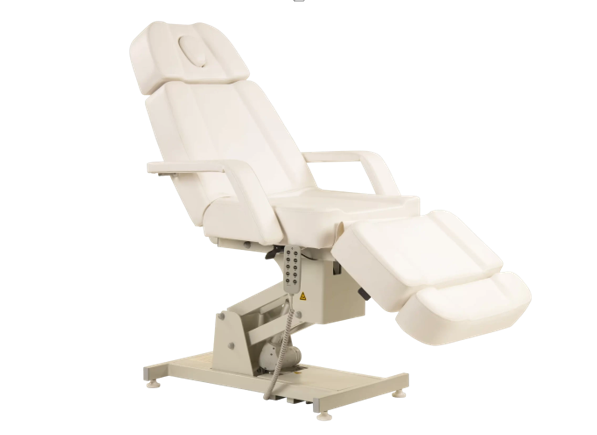
Motor count is the first thing to mention. With a one-motor chair, you can recline the backrest. This is pretty much it. A three- or four-motor chair allows you to control the backrest, leg rest, height adjustment, and tilt individually. Laser work needs a different patient angle than extractions. Microneedling needs a different positioning than a chemical peel.
The more independently the chair adjusts, the more precisely you can position your patient for each treatment. That precision cuts down on mid-procedure corrections and keeps your appointment running on time.
Programmable memory is worth the consideration if your clinic runs multiple doctors or a rotating set of procedures. The Mridul Derma Chair by Esthetica Medical Furniture carries a four-motor system with a programmable handset. A doctor who repeats the same procedure across multiple patients each day can save preferred positions and recall them with one press. No re-adjusting from scratch. No guesswork on angles.
See also: Franchise or Gamble? What New Pharma Partners Must Know Before They Begin
Upholstery Is a Clinical Decision, Not an Aesthetic One
Dermatology procedures involve topical products, peels, and occasional minor bleeding. Your chair surface takes repeated contact with these, and it takes repeated disinfection. UV-resistant, disinfectant-resistant upholstery is not a premium specification, it is a baseline for any clinical environment.
Chairs with substandard upholstery develop micro-tears. Those micro-tears trap product residue and create infection control risks. Accreditation audits and regulatory inspections look at this. More immediately, a chair that looks worn and cracked sends a signal to patients about your clinic’s standards that no amount of good treatment can easily reverse.
What the Right Chair Actually Does for You
Clinics that run productive, profitable schedules are not always the ones with the most expensive setups. They are the ones where each piece of equipment does its job without creating problems. The derma chair earns its place by keeping patients still and comfortable, giving your staff clean adjustment controls, and letting appointments run close to their scheduled time.
Choose the wrong one, and you feel it in small, daily ways for as long as that chair is in your room.
Choose the right one, and you’ll likely stop thinking about it. Which is exactly where you want to be.